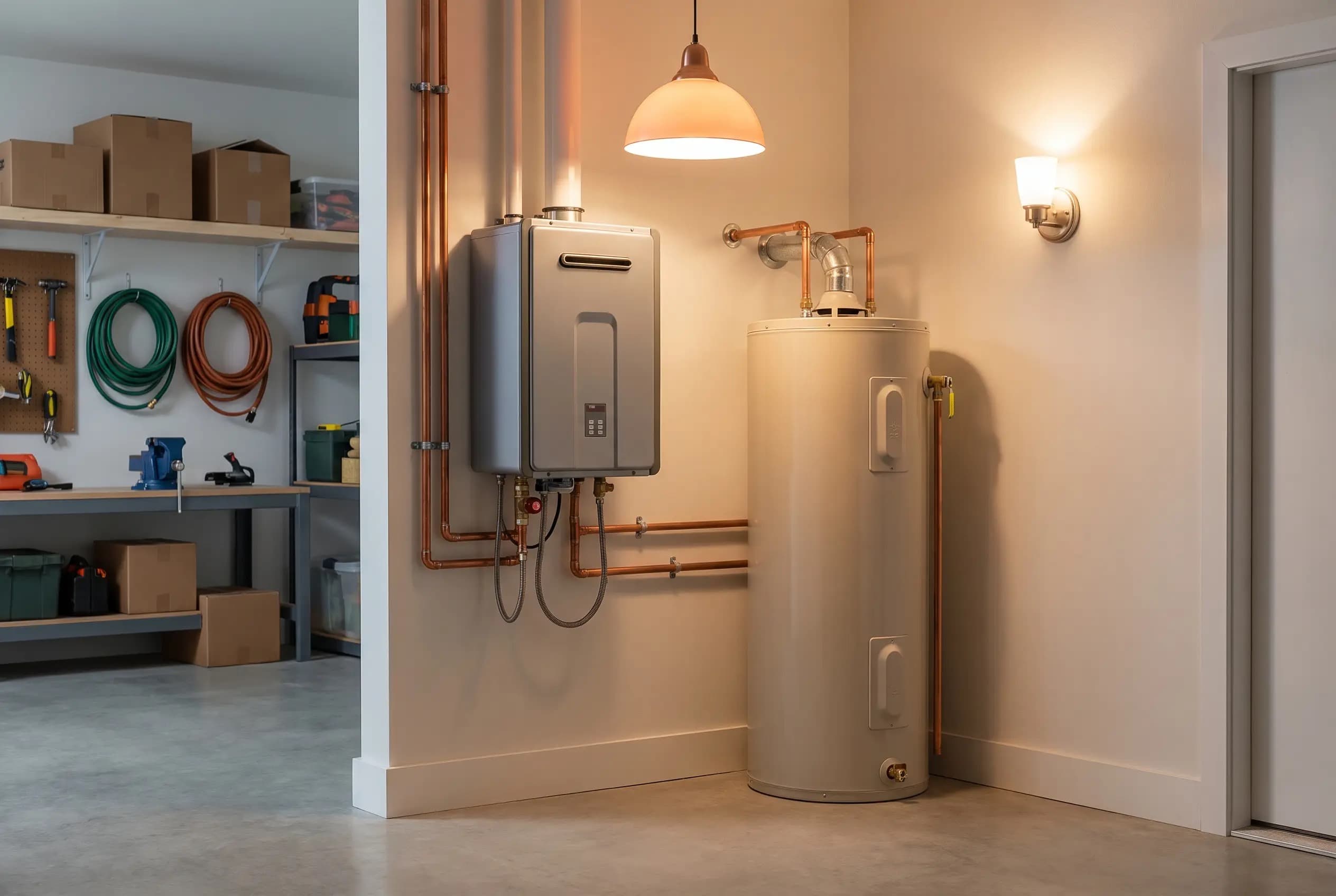
Tankless vs. Tank Water Heaters: Which Is Right for a Michigan Home?
There is no single right answer, and anybody who tells you otherwise is selling something. A tank heater costs less upfront, is simpler to install, and handles a busy morning without blinking. A tankless heater lasts longer, saves space, and gives you endless hot water, but it costs more to put in and our cold Michigan groundwater makes proper sizing critical. The right pick depends on your house, your gas line, and how your family actually uses hot water.
It is late February in Lansing, the ground is still frozen, and the water coming into your house is about as cold as it gets all year. That is exactly when tired water heaters give up. So if yours is groaning, rusting at the base, or leaving you with a lukewarm shower, you are probably wondering whether to replace it with another tank or make the jump to tankless. Let us walk through it plainly.
The short version of how each one works
A tank water heater keeps a big reservoir of water hot and ready, usually 40 to 50 gallons, so it is there the moment you turn the tap. A tankless unit heats water on demand as it flows through, firing up only when you call for it. Both do the same job. They just go about it differently, and those differences matter more in Michigan than they do in warmer states.
Cost, lifespan, and the honest tradeoff
A tank heater is cheaper to buy and simpler to install, which is why most Lansing homes still have one. The tradeoff is lifespan: a tank typically lasts around 10 to 12 years before the inside corrodes and it starts to leak. A tankless unit costs more upfront and often needs gas and venting upgrades, but it can run 20 years or more with basic care. If you plan to stay in your home a long time, that longer life changes the math. If you are moving in a few years, it may not. We quote a flat, upfront price either way before any work starts, so you can weigh it with real numbers instead of a guess. If you are already watching your energy bills, the efficiency side is worth talking through too.
The Michigan cold water problem nobody mentions
Here is the part the big-box sales pitch skips. A tankless heater has to raise the incoming water to your target temperature in real time. In summer that is easy. In February, when our groundwater is near freezing, the unit has to work much harder to hit the same shower temperature, and that lowers how many gallons per minute it can deliver at once. A tankless that looks plenty big on paper in Georgia can come up short in a Michigan winter if it is undersized.
This is why sizing is not a formality here. Get it right and a tankless is fantastic. Get it wrong and you get a cold surprise when two people need hot water on a January morning. A tank does not have this problem in the same way, because the water is already hot and waiting. It only runs out when the tank empties.
Side by side for a Michigan house
| What matters | Tank | Tankless |
|---|---|---|
| Upfront cost | Lower | Higher |
| Typical lifespan | About 10 to 12 years | 20 years or more with care |
| Hot water supply | Limited to tank size | Endless, up to a flow limit |
| Cold-inlet winters | Handles it, water is pre-heated | Must be sized for cold groundwater |
| Space used | Large floor footprint | Small, wall-mounted |
| Gas and venting | Usually reuses existing | Often needs upgrades |
| Maintenance | Occasional flush | Yearly descale, more so with hard water |
Space, gas, and venting realities
Tankless units are small and hang on the wall, which frees up floor space in a tight basement or closet. That is a real perk in older Lansing homes. But that convenience comes with plumbing behind it. A tankless burns a lot of gas in short bursts, so it often needs a bigger gas line and its own dedicated venting. In an older house, those upgrades can be the difference between an easy swap and a bigger project. A tank replacement, by contrast, usually reuses what is already there. None of this is a dealbreaker. You just want to know about it before you decide, not after.
Hard water and maintenance
A lot of mid-Michigan homes have hard water, and hard water leaves scale. In a tank, scale settles at the bottom and makes the unit work harder over time, so an occasional flush helps. In a tankless, scale builds up right on the heat exchanger where the action happens, and that shortens its life if you ignore it. Tankless units want a descaling roughly once a year, more often if your water is very hard. If you know your water is rough and you will not keep up with maintenance, be honest with yourself, because that changes which unit will actually serve you well.
A real example from over in Holt
A homeowner over in Holt called us in January because her 14-year-old tank was leaking onto the basement floor. She wanted tankless, mostly for the endless hot water and to reclaim the corner it sat in. Good instincts. But her house had two teenagers, one gas line running on the small side, and no soft water setup. We laid out both paths honestly. Tankless was a great fit for her long-term plans, so we sized it properly for our cold winter inlet, upgraded the gas line, and set her up on yearly descaling. Had she been planning to sell in two years, we would have steered her toward a straight tank swap instead. Same company, different answer, because the house and the family were different.
Where homeowners get burned
The most common trap is buying a tankless that was sized for mild weather and then being shocked when it cannot keep up during a Michigan cold snap. That is a sizing failure, not a product failure, and it is avoidable.
The second trap is skipping the gas and venting conversation. Someone quotes a cheap tankless price, then the real cost of the line and vent upgrades shows up mid-job. We would rather tell you the whole number upfront, flat and in writing, before the wrench comes out.
The third one is buying tankless for the longevity and then never descaling it. If you neglect it, you throw away the very lifespan advantage you paid for. The same discipline applies to any big system in the house, whether you are talking about a water heater or replacing aging equipment like a furnace.
So which should you pick?
It honestly depends on your house. Lean tank if you want the lower upfront cost, you have an active household with big simultaneous hot water needs, or you may move before a tankless pays off. Lean tankless if you plan to stay put for years, you want the space back, and you will keep up with yearly maintenance. Either way, the goal is matching the unit to how you actually live, not to whatever has the best margin.
If you are not sure which way to go, that is exactly the kind of call we like to get. We will look at your gas line, your water, and how your family uses hot water, then give you a straight recommendation and a flat, upfront price on new water heaters before any work begins. No pressure, no scare tactics. Reach out to us at /contact and we will help you sort it out.
Common questions
Frequently asked
Does a tankless water heater really run out of hot water?
It will not run out the way a tank does, because it heats water continuously. But it does have a flow limit, meaning only so many gallons per minute at once. In a Michigan winter that limit drops because the incoming water is so cold, which is why proper sizing matters here.
Is tankless worth the higher upfront cost in Michigan?
It can be if you plan to stay in your home for years, since a tankless often lasts twice as long as a tank. If you are likely to move soon, the longer lifespan may not pay off before you sell. We walk through both with a flat price so you can decide with real numbers.
Will my old house support a tankless unit?
Sometimes it needs a larger gas line and dedicated venting, especially in older Lansing homes. That does not rule it out, it just adds to the project. We check what you have before quoting so there are no surprises mid-job.
How much maintenance does each type need?
A tank benefits from an occasional flush to clear sediment. A tankless wants descaling about once a year, and more often if you have hard water. Skipping tankless maintenance shortens its life, so be honest about whether you will keep up with it.
My water heater is leaking. Do I have to decide right now?
A leaking tank should be handled quickly, since it will only get worse and can damage your floor. You do not have to rush the tank-versus-tankless decision under pressure, though. Give us a call and we will help you make the right long-term choice while sorting out the immediate problem.
Keep reading