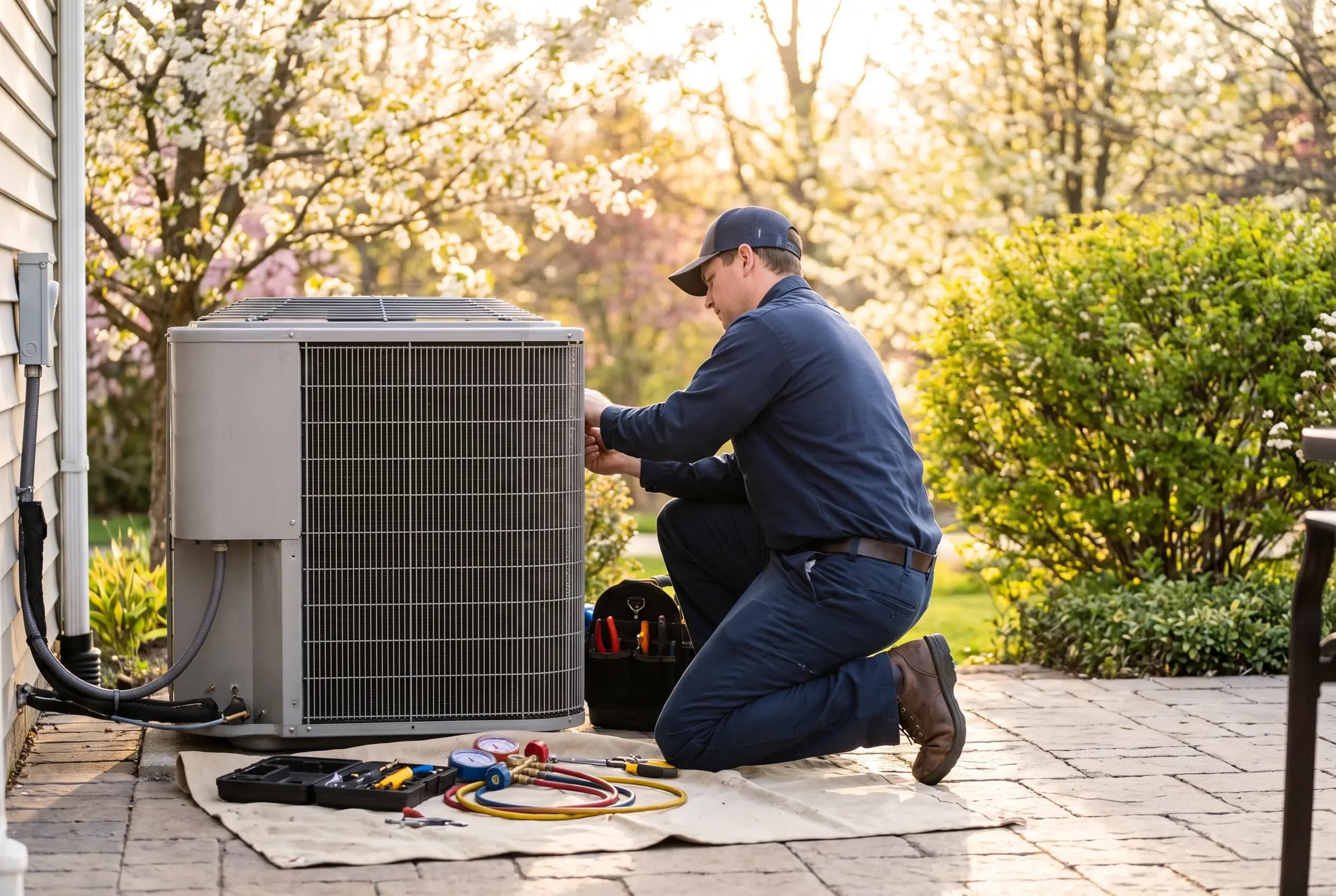
What Should a Spring AC Tune-Up Cover?
A good spring AC tune-up clears and cleans the outdoor condenser, checks the refrigerant charge, cleans the coils, flushes the condensate drain, swaps the filter, verifies the thermostat, inspects the electrical connections and capacitor, checks the blower, and runs a full cooling cycle to confirm the system actually cools. Some of that you can handle in an afternoon. The rest needs gauges, meters, and a trained set of eyes. The point is to catch small problems in April, before the first humid stretch in July turns them into a no-cool emergency.
Michigan does not ease into summer. We go from raw, wet spring mornings to sticky 90-degree afternoons in what feels like a week. If your air conditioner sat untouched all winter, the first real hot spell is the worst possible time to find out it will not keep up. Early April is the sweet spot. The equipment is cool, techs are not slammed yet, and you have time to fix whatever turns up.
What a full tune-up actually covers
A tune-up is not one thing. It is a run through the whole system, indoors and out, looking for the small stuff that quietly kills efficiency or leaves you stranded in August. Here is the checklist we work through, top to bottom.
- Clear and clean the outdoor condenser. Cut back weeds and shrubs, pull out leaves and cottonwood fluff, and rinse the fins so air moves freely through the unit.
- Check the refrigerant charge. A system low on refrigerant cools poorly and works itself to death. Low charge almost always means a leak, not normal use.
- Clean the coils. The outdoor condenser coil and the indoor evaporator coil both shed heat. Caked with dirt, they cannot, and your energy bill climbs.
- Flush the condensate drain. The line that carries off humidity clogs with algae and slime. A backed-up drain means water on your floor or a shut-down system.
- Change the air filter. A dirty filter chokes airflow, ices the coil, and strains the blower. Cheapest fix on the list and one of the most important.
- Verify the thermostat. Confirm it reads accurately, switches to cool correctly, and holds the setting. If it is an older mercury or basic model, this is a good time to consider an upgrade.
- Inspect the electrical and capacitor. Tighten loose connections, look for scorching, and test the start and run capacitors that get the compressor and fan motors going.
- Check the blower. The indoor blower moves your conditioned air. A dirty wheel or worn belt drops airflow through the whole house.
- Run a full cooling cycle. Start to finish, watch it cool, check the temperature drop across the coil, and listen for anything that does not sound right.
What you can do yourself, and what needs a tech
Plenty of this list is honest homeowner work. You do not need us to rake leaves off your condenser or swap a filter. But a few items need gauges, meters, and training, and guessing at them does more harm than good. Here is the honest split.
| Task | Who handles it | Why |
|---|---|---|
| Clearing brush and leaves from the condenser | You | Just needs hands, gloves, and a garden hose on a gentle setting. |
| Changing the air filter | You | Simple swap you should be doing every one to three months anyway. |
| Rinsing the outdoor fins | You | Fine with low water pressure. Never use a pressure washer, which bends the fins. |
| Setting and testing the thermostat | You | You can confirm it switches to cool and holds a setting. |
| Checking refrigerant charge | Tech | Requires gauges and EPA certification. A low charge signals a leak that needs finding. |
| Cleaning the evaporator coil | Tech | It sits inside the air handler and needs proper access and cleaner. |
| Testing the capacitor and electrical | Tech | Live electrical work with a meter. Not a DIY job. |
| Inspecting the blower and motor | Tech | Needs the cabinet opened and the wheel and belt assessed. |
If you want the deeper background on how these systems are matched to a house in the first place, our note on sizing your AC correctly pairs well with this one. A tune-up keeps a right-sized system healthy. It cannot fix one that was oversized on the day it went in.
A tune-up that earned its keep
A homeowner over in Holt called us one April, a couple weeks before the heat arrived. Nothing was wrong, she just wanted the system looked at before summer. Good instinct. When we pulled the panel, the capacitor was bulged at the top, the tell-tale sign it was about to fail. The unit still ran, so she never would have known. If that capacitor had let go on the first 90-degree Saturday in July, the compressor would have sat there straining, and we would have been talking about a much bigger repair instead of a ten-minute part swap.
That is the whole argument for spring service in one story. You are not paying to fix a breakdown. You are paying to not have one.
Where homeowners get burned
Most tune-up regret does not come from the tune-up. It comes from skipping one, or from hiring the wrong outfit. A few traps we see every spring:
- Waiting until the first heat wave. By then every honest shop in town is booked solid, and you are stuck waiting days in a hot house.
- Treating a filter change as a full tune-up. A fresh filter helps, but it does nothing for a weak capacitor, a low charge, or a clogged drain line.
- Pressure-washing the condenser. It feels thorough, but it flattens the aluminum fins and chokes the airflow you were trying to protect.
- Falling for the free inspection that becomes a sales pitch. Some companies use a cheap tune-up as a door opener, then push a new system you do not need. We do not run commissioned techs, so nobody here earns a bonus for scaring you.
- Ignoring what SEER2 tells you. If your unit is fifteen-plus years old and limping, understanding what SEER2 means helps you judge whether another repair is worth it or whether replacement finally makes sense.
How often, and what it buys you
Once a year, in spring, is the right rhythm for a cooling system. Pair it with a fall visit for the furnace and you have both halves of the house covered before each hard season. A yearly tune-up keeps efficiency up, catches small failures while they are cheap, and generally stretches the life of the equipment. It is the least glamorous money you will spend on your home and some of the best.
If you are not sure whether your system needs a full tune-up or just a filter and a rinse, that is exactly the kind of call we like to get. Reach out through our air conditioning page and we will give you a straight answer and an upfront flat price before any work starts. No pressure, no commissioned techs, no scare tactics.
Common questions
Frequently asked
When is the best time to schedule a spring AC tune-up in Lansing?
Early to mid April is ideal. The weather is still cool, so the system can be tested calmly, and technicians are not yet buried in no-cool emergencies. Booking before the first humid stretch means any repair gets handled before you actually need the air conditioning.
How often should I have my air conditioner tuned up?
Once a year, every spring, is the right cadence for a residential system. Annual service keeps efficiency up and catches small failures like a weak capacitor while they are still cheap fixes. Pair it with a fall furnace visit and both halves of your comfort system stay covered.
Can I do a spring AC tune-up myself?
You can handle a good chunk of it: clearing brush off the outdoor unit, gently rinsing the fins, changing the filter, and testing the thermostat. The refrigerant charge, coil cleaning inside the air handler, and electrical and capacitor checks need a trained tech with the right tools. Think of the homeowner tasks as maintenance and the tech tasks as the actual inspection.
Why does my AC need a tune-up if it seems to be running fine?
A system can run and still be quietly failing. A bulging capacitor, a slow refrigerant leak, or a partly clogged drain will not stop the unit today, but they can leave you stranded on the hottest day of the year. A spring tune-up finds those problems while they are small and inexpensive to fix.
Will a tune-up lower my energy bills?
Often, yes. Dirty coils, a choked filter, and a struggling blower all force the system to run longer and draw more power to do the same job. Cleaning those up restores the airflow and heat transfer the system was designed for, which shows up on your summer bills.
What is the difference between a tune-up and a repair?
A tune-up is planned maintenance: cleaning, testing, and inspecting a working system to keep it that way. A repair fixes something that has already broken. The whole point of spring service is to stay in the first category and avoid the second, usually at a fraction of the cost and stress.
Keep reading